
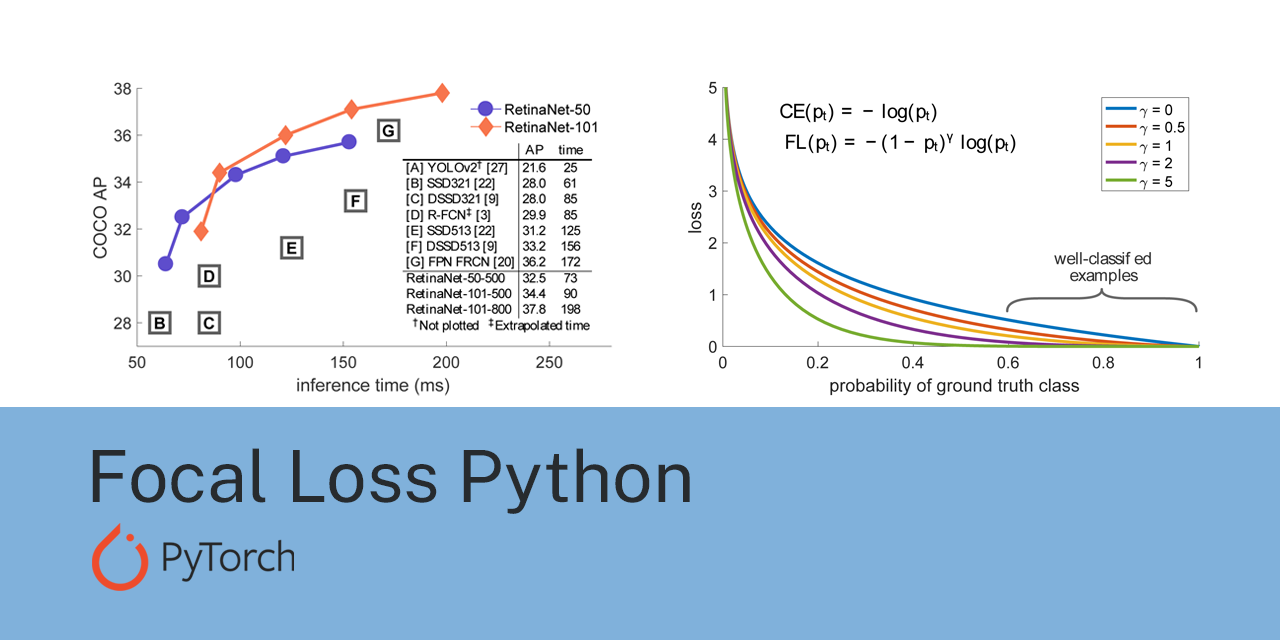
This repository contains an implementation of Focal Loss, a modification of cross-entropy loss designed to address class imbalance by focusing on hard-to-classify examples. This implementation is based on the paper [1]:
Focal Loss for Dense Object Detection
*By Tsung-Yi Lin, Priya Goyal, Ross Girshick, Kaiming He, and Piotr Dollár
The focal_loss class in this repository supports the following tasks:
- Binary Classification
- Multi-class Classification
- Multi-label Classification
- Gamma (γ): Focusing parameter to reduce the loss for well-classified examples.
- Alpha (α): Class balancing factor to adjust the loss contribution of each class.
- Reduction: Specifies the reduction method (
'mean','sum', or'none').
Focal Loss modifies the standard cross-entropy loss by adding a modulating factor (1 - p_t) ** gamma to focus learning on hard misclassified examples. It's particularly useful for addressing class imbalance in datasets, especially in object detection tasks, as originally described in the paper by Lin et al.
The general form of Focal Loss is:
Where:
-
$p_t$ is the model's estimated probability for the true class:- For correctly classified examples,
$p_t$ is high. - For misclassified examples,
$p_t$ is low.
- For correctly classified examples,
-
$\alpha_t$ is the class balancing factor for the true class$t$ . -
$\gamma$ is the focusing parameter that adjusts the rate at which easy examples are down-weighted.
For binary classification, where each instance belongs to one of two classes (0 or 1), the Focal Loss becomes:
-
$p = \sigma(x)$ is the predicted probability after applying the sigmoid function. -
$y \in {0, 1}$ is the ground truth label. -
$\alpha$ balances the importance of positive and negative examples.
For multi-class classification with
-
$p_t = \text{Softmax}(x)_t$ is the predicted probability for the true class$t$ . -
$\alpha_t$ is the class-specific weighting factor. - The loss is summed over all classes and averaged over the batch.
For multi-label classification, where each instance can belong to multiple classes simultaneously, the Focal Loss is applied independently for each class:
-
$p = \sigma(x)$ is the sigmoid activation applied per class. -
$y \in {0, 1}^C$ is the ground truth label vector. - The loss is computed for each class and then summed or averaged.
Install the Torch dependency:
- Windows:
pip install -r requirements.txt - Linux:
pip3 install -r requirements.txt
You can use the FocalLoss class for different classification tasks by setting the task_type argument.
import torch
from focal_loss import FocalLoss

criterion = FocalLoss(gamma=2, alpha=0.25, task_type='binary')
inputs = torch.randn(16)  # Logits from the model (batch_size=16)
targets = torch.randint(0, 2, (16,)).float()  # Ground truth (0 or 1)

loss = criterion(inputs, targets)
print(f'Binary Focal Loss: {loss.item()}')import torch
from focal_loss import FocalLoss
num_classes = 5
alpha = [1.0] * num_classes # Example class weights
criterion = FocalLoss(gamma=2, alpha=alpha, task_type='multi-class', num_classes=num_classes)
inputs = torch.randn(16, num_classes) # Logits from the model
targets = torch.randint(0, num_classes, (16,)) # Ground truth labels
loss = criterion(inputs, targets)
print(f'Multi-class Focal Loss: {loss.item()}')import torch
from focal_loss import FocalLoss
num_classes = 5
criterion = FocalLoss(gamma=2, alpha=0.25, task_type='multi-label')
inputs = torch.randn(16, num_classes) # Logits from the model
targets = torch.randint(0, 2, (16, num_classes)).float() # Ground truth labels
loss = criterion(inputs, targets)
print(f'Multi-label Focal Loss: {loss.item()}')[1] Lin, T.-Y., Goyal, P., Girshick, R., He, K., & Dollar, P. (2017). Focal loss for dense object detection. 2017 IEEE International Conference on Computer Vision (ICCV). https://doi.org/10.1109/iccv.2017.324